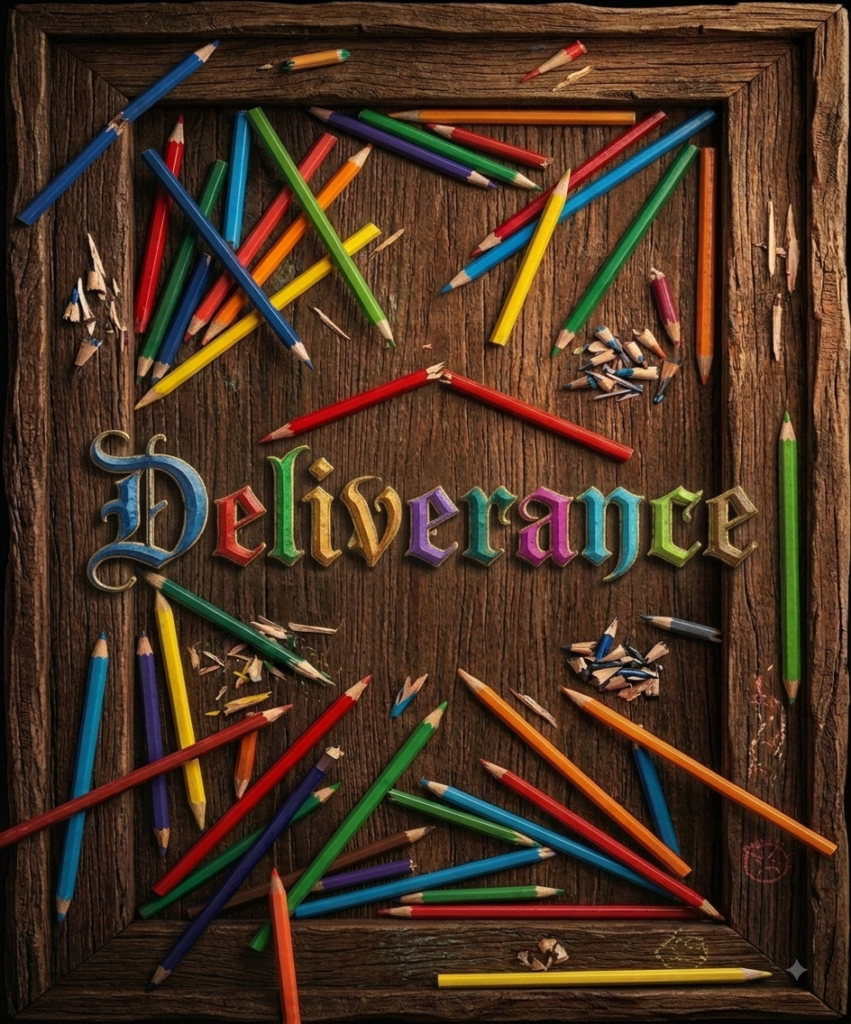
DELIVERANCE
By Merit Gogo-fyneface
Viam. Viam.
I saw the cane curl upward as Baba lifted his hands. It came down on my back – the first, the second, the third until I could no longer count. Each stroke sank into my skin, rising and falling without end, leaving bits of koboko on the floor. I screamed, but Baba did not mind. If anything, the strokes began to match the velocity of my wails. I held my frustration between my teeth, but it did not stop.
I tried to move away, but I was brought back by Papa, right within reach, pressing my sweaty palm back after each whack.
This is wickedness dressed up as deliverance and if I left the world this way, Papa would be to blame. Only – the man did not care. He was tired of waiting for my mind to catch up with my name: Bright. There was nothing bright about me. Not my skin or the way I felt inside.
What kind of deliverance takes a child’s breath and still collects his father’s money? Money that should have bought bread and eggs that morning was placed in Baba’s hands instead – a very old man in long white garments who said he would travel with it to see Jesus Christ, who would free me from everything happening inside me.
Baba’s God did not feel like the real one. He was definitely not the one we sang hymns to or the one in Bible stories. I had never known a God who needed whips to save a child when Jesus had already died.
I hate this place.
A scattered compound of dilapidated buildings. It looked like ours but we kept ours neat and domestic animals did not move freely through the sand, littering faeces baked dry by the hot sun. I was made to kneel on the dirty, cracked cement floor as flies buzzed through the air, picking at food debris and returning with others from their swarm. The floor was unswept. Sand pressed into my knees and in all of this decay , I was still being whipped.
Baba spoke to Papa in low tones. Then another whip came without warning or explanation.
Papa sat there praying as if repetition could make this punishment holy.
When it ended, he thanked Baba. My back was burning, I dried my tears and there was a small girl looking at me with disgust through a torn window net from the building across as if there was no justification for my wailing. I plastered my eyes to the floor knowing fully well that she could not survive the lightest of those strokes. I remember thinking: Papa might also need deliverance, because what kind of man thanks another human being for beating his child for thirty minutes?
The day before, Papa had been staring at my school books. The zeroes stared back , I watched him shake his head and I was afraid of swallowing my food in his presence because even our teacher said , it was written in the Bible, ‘He who does not work should not eat.’ Papa could not read everything clearly; he was not educated but the neighbours could and in our place, neighbours never stayed quiet about a child’s failure. Success travelled slowly and became a communal victory but when it was failure, it was specific and traced to only your abode, travelling fast.
That night, I heard him whisper to Mama. Something must be done. It was worse because I was the only son. No sibling to absorb the weight. Only me and Papa felt he could not fail in his job – to make me worthy.
I listened in class. I tried. I listened when our teacher came in wearing the same shoes all week, the same faded blouse, still speaking about education and telling us it was the key , a key that had locked her inside this village.
Still, they said I was not trying enough.
I saw Papa work hard , selling farm products that filled our soup pot and bought me books at school. My kind of hard was football – movement that made sense in my body. Papa did not understand me, no one did. He said I would grow up and I would be a Medical Doctor.
Another zero appeared so deliverance was arranged. Mama waited at the door that day, touching my face with something between satisfaction and pain. The demons had been driven out, they said. In Mama’s eyes I could tell she wished there was another way. Hot water waited in a brown pot. She bathed me, fed me, said nothing – like words might drag the tears forming in my eyes again.
“ He is a man. He will get over it.” Papa said on seeing Mama seated in sobriety and staring occasionally at me.
Nothing changed the next week. Another zero, more talks and worrying for a ten year old who wanted to be left alone.
Then Aunty’s car arrived. Half naked children , old women running after it like they feared nothing , in excitement they loitered and began to greet her as she stepped out of the back seat of her Mercedes.
I did not know what to feel because I would leave Eleme and I would fly in an aeroplane. I would start again, as if nothing had ever happened here. Mama said they would be fine and from time to time, they would make it to the city to see me. Only one thing gave me joy: there would be no Baba to whip me anymore.
We drank chilled bottles. One was mine – something that hardly happened in our home. Aunty moved like a lion within our small house , pointing to the mattress that needed to be changed and telling Mama of items she would be sending when she got back to the city.
Sadness and celebration mixed as they discussed my journey to the city. They spoke of how useful I might become, it was a good feeling to watch others think of me as lucky, to be on the side of victory, not being a spectator or thinking evil things at the end of school year, like the headmistress falling off our rickety podium so that no awards will be given because my name would not be called. Nothing of that sort ever happened, everything on the paper happened, first position, second position and the other children finding me in the class to laugh again for coming last.
***
A short boy showed me to my new room with pride I did not understand as we arrived at Aunty’s house that Sunday afternoon. There was hot rice and spicy stew, its rich oil rising and sinking as the spoon dipped into it in the dining room. Aunty welcomed me to my new home and so did everyone. Her husband smiled at me once and I never saw his teeth again. They were buried in a newspaper.
Papa had sent me to the city to kill me.
My first day at school should never have happened. It was a large school with small classrooms and too many watching eyes. I was placed beside a boy who refused to answer me when I asked what his name was.The only time he spoke, all he had said was “sut up.” At noon, a girl dug her fingernails into my face during play and no one punished her. They smiled and told her to stop. I understood immediately: this place was not good for me.
I hid every other day, I found new places, but Aunty always found me. I would rather face Baba’s whip than the fear of hands reaching me from behind.
Until I broke my white board, broke my pencil, and scattered everything in the classroom, they did not listen.
Aunty was called. Then Mama and they decided I would see the Reverend. So, after church, rice and oily stew was delayed, Aunty held me by my hands and we joined a queue outside the Pastor’s office.
Why was it so difficult to see a human being? In Eleme anyone could walk to the Pastor and there was no austere looking adult manning the doors as if he had the key to heaven. The door was shut after each entry, a pregnant woman, a man on crutches and when it was our turn, we went in. The Reverend looked at me and said, ‘Bright boy’ as our eyes met and I watched Aunty’s smile fall quietly out of her face and I wondered – what my life would be.